Cart
0
What the GOTS label means, what it covers and why it matters when choosing organic textiles
When shopping for clothing made with organic cotton, you may have come across the term GOTS Certified.
But what does it actually mean?
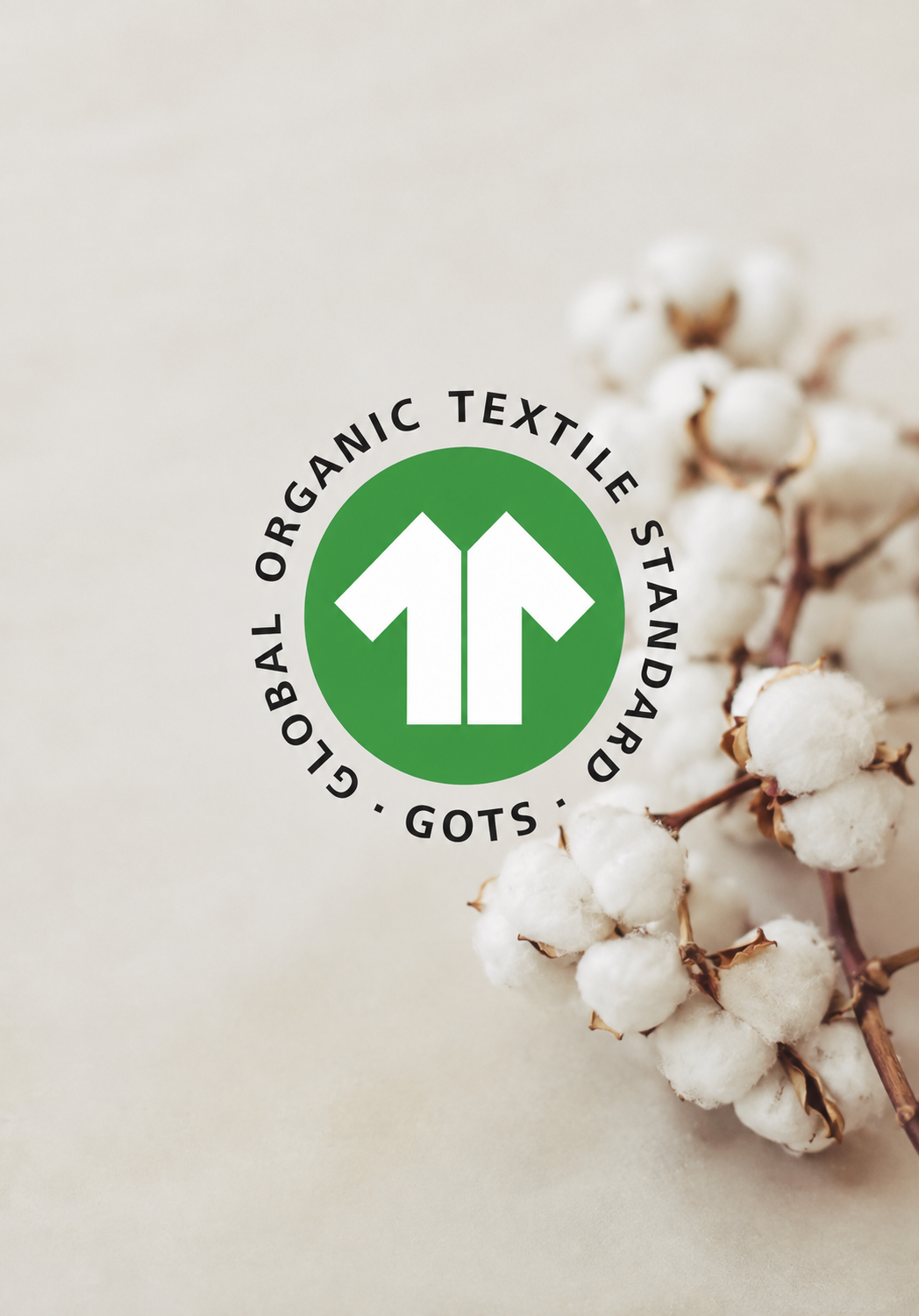
GOTS, or the Global Organic Textile Standard, is one of the world's leading standards for textiles made with certified organic fibres. It combines requirements for organic fibre content with environmental, chemical, human-rights and social criteria across textile processing and manufacturing. Compliance is verified through independent third-party certification.
In other words, GOTS goes considerably further than simply asking whether the cotton in a garment was organically grown.
GOTS IN ONE SENTENCE
GOTS is a textile processing standard that follows certified organic fibres through the manufacturing supply chain—from initial processing to the finished textile product.
For consumers trying to understand what sits behind an "organic" claim, that distinction matters.
What Does GOTS Stand For?
GOTS stands for Global Organic Textile Standard.
The standard establishes requirements for textiles made with certified organic natural fibres and covers multiple stages of processing and manufacturing.
Depending on the product, this can include:
- fibre processing
- spinning
- knitting or weaving
- dyeing
- finishing
- garment manufacturing
- labelling
GOTS requires relevant processing stages in the certified supply chain to comply with its criteria rather than certifying only one isolated stage of production.
This is one of the key differences between GOTS certification and a simple statement that a garment "contains organic cotton."
Does GOTS Certify Organic Cotton?
This is an important distinction.
Technically, GOTS does not certify raw cotton as organic.
Raw fibres entering the GOTS supply chain must already be certified organic according to an accepted organic farming standard. GOTS then applies to the subsequent textile processing and manufacturing stages.
ORGANIC FIBRE VS. GOTS-CERTIFIED TEXTILE
Organic fibre certification verifies how the agricultural fibre was produced.
GOTS certification addresses what happens as those certified organic fibres are transformed into textiles and finished products.
The two work together, but they are not the same thing.
This is why a more precise description is "a GOTS-certified textile made with certified organic cotton" rather than treating "GOTS-certified cotton" as an agricultural certification.
What Does GOTS Certification Cover?
GOTS is designed to address several different parts of textile production within one standard.
Its key areas include:
- certified organic fibre requirements
- chemical input restrictions
- environmental management
- wastewater requirements
- resource efficiency
- human-rights and social criteria
- product safety requirements
- traceability throughout certified processing stages
- independent third-party certification
The current GOTS framework also includes requirements relating to areas such as greenhouse-gas management and increasingly detailed supply-chain due diligence.
This broader scope is what makes GOTS more than an organic-fibre claim.
It looks not only at what a textile is made from, but also at important aspects of how that textile is processed and manufactured.
What Are the GOTS Organic Fibre Requirements?
GOTS has two principal label grades.
Organic
Products carrying the "Organic" label grade must contain at least 95% certified organic fibres.
Made with Organic Materials
Products carrying the "Made with Organic Materials" label grade must contain at least 70% certified organic fibres.
This distinction is useful because not every GOTS-certified textile necessarily consists of 100% organic fibres.
Certain additional fibres can be permitted within limits defined by the standard.
DON'T STOP AT THE LOGO
When looking at a GOTS-labelled product, check which label grade applies.
Organic: at least 95% certified organic fibres.
Made with Organic Materials: at least 70% certified organic fibres.
What Environmental Requirements Does GOTS Include?
Textile manufacturing involves considerably more than fibre production.
Fibres may be washed, spun, knitted or woven, dyed, printed, finished and assembled before reaching the consumer.
GOTS therefore includes environmental and chemical requirements across textile processing.
According to the standard's official criteria, these areas include:
- restrictions on chemical inputs
- wastewater treatment
- resource efficiency
- greenhouse-gas emissions management
- manufacturing and processing requirements
- product-safety criteria
Chemical inputs used in relevant wet-processing stages must meet GOTS requirements before they can be used in GOTS goods.
The latest GOTS Version 8.0, released in March 2026, further strengthened requirements in areas including chemical management, emissions, waste, product safety and circularity.
Organic agriculture is only the beginning of a textile's journey.
Dyeing, finishing and manufacturing matter too—which is precisely why textile-processing standards are important.
What Social and Human-Rights Standards Does GOTS Include?
GOTS is not solely an environmental standard.
Its certified entities must also comply with human-rights and social criteria aligned with internationally recognised frameworks.
These include requirements concerning:
- safe and hygienic working conditions
- prohibition of forced labour
- prohibition of child labour
- freedom of association and collective bargaining
- non-discrimination
- protection against harassment and violence
- working time
- remuneration
- responsible employment practices
These criteria form part of the broader GOTS certification system applied to textile processing and manufacturing.
This matters because a textile's impact cannot be understood by examining fibres and chemicals alone.
People are part of the supply chain too.
How Is GOTS Certification Verified?
GOTS is backed by independent third-party certification.
Companies participating in the certified textile supply chain must meet the applicable requirements and be certified by approved certification bodies.
For products carrying GOTS labelling, the official label must also include required certification information, including the relevant label grade, certification body reference and licence number.
WHY THIRD-PARTY CERTIFICATION MATTERS
A brand saying "we use responsible materials" is a company claim.
Independent certification introduces defined criteria and external verification.
It doesn't make a product perfect—but it gives consumers more information with which to evaluate the claim.
Is GOTS Better Than an "Organic Cotton" Claim?
The two statements tell you different things.
A claim that a garment contains organic cotton primarily describes the agricultural origin of the fibre.
A properly certified GOTS product provides additional information about textile processing and manufacturing, because GOTS applies environmental, chemical and social requirements throughout the certified processing supply chain.
For example, GOTS can address areas that the words "organic cotton" alone do not explain, including:
- chemical inputs
- dyeing and processing
- wastewater treatment
- manufacturing requirements
- human-rights and social criteria
- third-party verification
So the useful question isn't:
"Is GOTS better than organic cotton?"
It is:
"Does the claim describe only the fibre - or does it also tell me something about how the textile was processed and manufactured?"
Is GOTS the Highest Organic Textile Certification?
It is better to avoid describing any certification as universally the "highest", because different standards can evaluate different issues.
GOTS describes itself as a leading global textile-processing standard for organic fibres and is widely used internationally. Its significance comes from combining organic fibre requirements with environmental, chemical and human-rights criteria across textile processing, backed by independent certification.
For consumers, that makes it one of the most comprehensive certifications to understand when shopping for organic textiles.
How Can Consumers Recognise a Genuine GOTS Product?
The word "GOTS" should not simply be treated as a marketing adjective.
Official GOTS labelling is subject to specific rules.
When checking a product, look for:
- the official GOTS logo where applicable
- the relevant label grade
- the approved certification body
- the certified entity's licence number
- clear fibre-composition information
GOTS states that companies using its signs or representing textile products as GOTS certified must meet its certification and labelling conditions.
A GOOD HABIT WHEN SHOPPING
Don't just look for the word "certified."
Ask:
Certified to what standard?
By whom?
What exactly does that certification cover?Specific information is much more useful than vague sustainability language.
Does GOTS Mean a Product Is Completely Sustainable?
No.
No single certification can capture every environmental or social consideration associated with a garment.
A product's overall impact can also depend on factors such as:
- how often it is worn
- durability
- transportation
- packaging
- washing and drying
- repairability
- end-of-life treatment
- consumer behaviour
GOTS should therefore be viewed as evidence that defined textile-production requirements have been met, not as proof that a garment has zero impact.
CERTIFICATION ≠ PERFECTION
Certification gives us standards, verification and greater transparency.
It does not turn a complex product into an impact-free one.
That distinction makes sustainability communication more credible—not less.
What Is GOTS Version 8.0?
GOTS periodically updates its standard as textile production, science, regulation and supply-chain expectations evolve.
GOTS Version 8.0 was released in March 2026.
The new version strengthens several areas, including:
- chemical-management requirements
- PFAS controls
- product-safety criteria
- air emissions
- waste management
- greenhouse-gas management
- worker protections
- supply-chain due diligence
- circularity provisions
GOTS states that Version 8.0 becomes fully effective after its transition period on 1 March 2027.
This is worth highlighting because certification standards are not static.
They evolve as expectations around responsible textile manufacturing evolve.
Is GOTS Only for Cotton?
No.
GOTS applies to textiles made from a range of certified organic natural fibres.
These can include plant-based fibres such as:
- cotton
- flax/linen
- hemp
- jute
and animal fibres such as:
- wool
- cashmere
- mohair
- alpaca
- silk
provided that the relevant organic fibre and GOTS requirements are satisfied.
Organic cotton may be one of the most familiar examples, but GOTS is a textile standard - not a cotton-only standard.
Can GOTS-Certified Clothing Contain Elastane?
Potentially, yes.
A GOTS-certified product does not necessarily need to contain 100% organic fibre.
Because the "Organic" label grade requires at least 95% certified organic fibres and "Made with Organic Materials" requires at least 70%, certain permitted additional fibres may be used within the limits and conditions defined by the standard.
This can be particularly relevant for products such as underwear and other garments where stretch and recovery are functional requirements.
The important point is that any additional fibres must comply with the applicable GOTS criteria rather than assuming that any blend is automatically permitted.
Why Does GOTS Certification Matter?
Sustainability claims can be difficult for consumers to evaluate.
Words such as:
natural
organic
responsible
conscious
eco-friendly
may sound reassuring, but their meaning can vary dramatically when they are not connected to clear criteria.
Certification can help replace some of that ambiguity with something more concrete:
standards, traceability and independent verification.
GOTS does not answer every question about a garment.
But it can answer several important ones about how certified organic fibres move through textile processing and manufacturing.
Transparency becomes more useful when claims can be checked.
And that is perhaps the most important role of certification.
GOTS and PURE LAYERS
At PURE LAYERS, certified organic fibres and transparent textile production are part of how we think about quality and responsibility.
Our essentials are made entirely in Italy using organic cotton selected according to recognised certification requirements, while our textile production partners work within certified processes where applicable.
For us, standards such as GOTS matter because the word "organic" should tell only the beginning of the story.
We also want to understand:
How was the fibre transformed into fabric?
Which processes were used?
Who made the garment?
Which standards can support the claims we make?
Certification is not the destination.
It is one of the tools that helps make those answers more transparent.
OUR APPROACH
We don't believe a sustainability claim becomes meaningful simply because it sounds good.
It becomes more meaningful when there is information, traceability and verification behind it.
For us, better clothing begins with better questions.
And certification helps make some of the answers visible.
Frequently Asked Questions About GOTS Certification
What does GOTS stand for?
GOTS stands for Global Organic Textile Standard, a textile-processing standard for products made with certified organic fibres.
What percentage of organic fibre is required for GOTS?
The "Organic" label grade requires at least 95% certified organic fibres, while "Made with Organic Materials" requires at least 70%.
Does GOTS certify the entire textile supply chain?
GOTS requires certification across the relevant textile processing and manufacturing stages, from the processing of certified organic fibres through to the finished product. Raw agricultural fibres themselves are certified under accepted organic farming standards before entering the GOTS chain.
Is GOTS only for organic cotton?
No. GOTS can apply to a range of certified organic natural fibres, including cotton, linen/flax, hemp, wool and silk.
Does GOTS include labour standards?
Yes. GOTS includes human-rights and social criteria addressing areas such as safe working conditions, child and forced labour, discrimination, freedom of association, working time and remuneration.
Does GOTS regulate chemicals used in textile production?
Yes. GOTS establishes criteria and restrictions for chemical inputs used during textile processing, including requirements for wet-processing chemicals.
Does GOTS mean a garment is 100% organic?
Not necessarily. The "Organic" label grade requires at least 95% certified organic fibres, while the "Made with Organic Materials" grade starts at 70%.
Does GOTS mean a garment is completely sustainable?
No. GOTS verifies compliance with defined criteria within its scope. It does not mean that a garment has no environmental or social impact.